
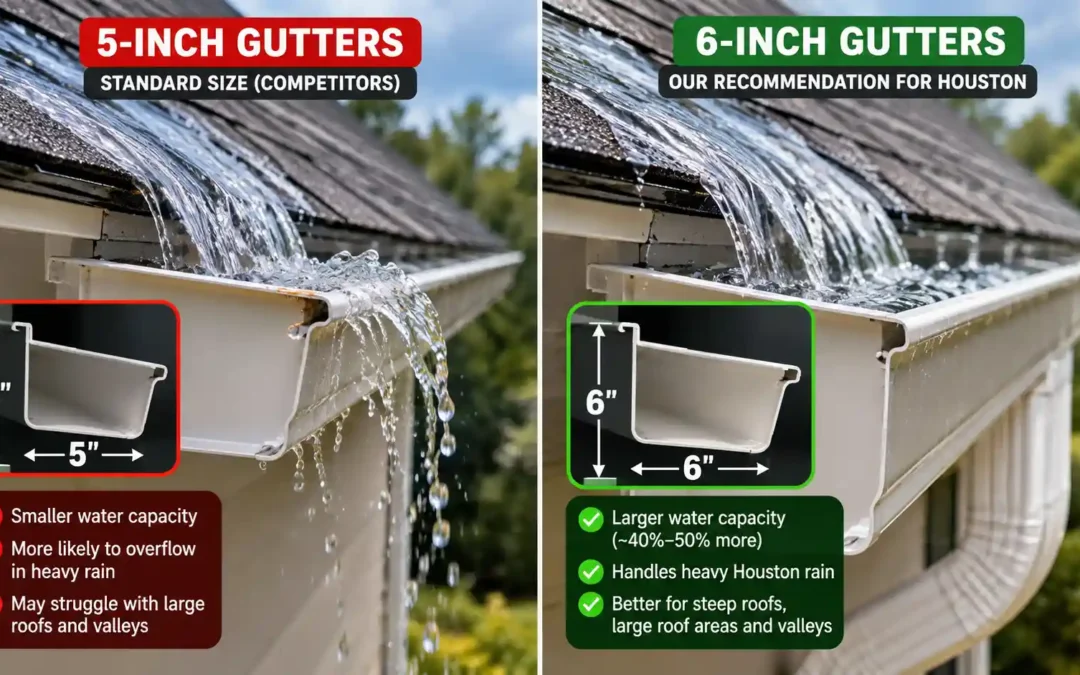
5-Inch vs. 6-Inch Gutters: Which Size Is Better for Houston Homes?
When comparing 5-inch vs. 6-inch gutters, a 6-inch K-style system provides substantially more drainage capacity and is often better suited to Houston homes with steep roofs, large drainage areas, long gutter runs, concentrated valleys, or heavy rainfall exposure. A properly designed 5-inch system can still perform well on smaller, lower-slope roofs with shorter runs and adequate downspout capacity.
Choosing a gutter size is not simply an aesthetic decision. Gutters are part of a larger roofline water-management system that includes roof pitch, valleys, fascia, downspouts, discharge locations, and ground drainage.
That distinction matters around Houston, The Woodlands, Spring, Katy, Cypress, Sugar Land, and Kingwood, where short-duration rainfall can place a large amount of water on a roof quickly. NOAA Atlas 14 data near downtown Houston, for example, estimates about 2.3 inches of rain in 60 minutes for a 2-year event and 4.9 inches for a 100-year 60-minute event. National Weather Service
The right question is therefore not simply, “What size gutters do I need?”
It is: How much water reaches this section of the roofline, and how efficiently can the entire system move it away?
The Core Difference: Dimensions, Water Capacity and Physics
A 6-inch gutter is wider and deeper than a standard 5-inch gutter, giving it a larger cross-sectional area.
That additional area translates into substantially greater hydraulic drainage capacity. Depending on the exact K-style profile and installation conditions, a 6-inch gutter can provide roughly 40%–50% more carrying capacity than a comparable 5-inch system.
You may also see approximate figures such as 1.2 gallons per linear foot for some 5-inch profiles and around 2 gallons for some 6-inch profiles. Those figures should be treated as profile-dependent estimates rather than universal engineering specifications; actual capacity varies with gutter shape, slope, outlets, and manufacturer dimensions.
More important than the raw volume is what happens while the storm is occurring.
Water is entering and leaving the gutter simultaneously. The real system capacity therefore depends on:
Roof runoff entering the gutter → gutter conveyance → outlet capacity → downspout discharge.
A larger trough helps, but it cannot compensate for every other drainage problem.
Why TXN Uses .032 Seamless Aluminum
TXN Home Services commonly fabricates 6-inch .032-gauge seamless aluminum gutters on-site.
The material is roll-formed at the property to match individual gutter runs. Seamless gutters have fewer seams than sectional gutter systems, reducing the number of joints along straight runs.
They are not literally seam-free.
Corners or miters, end caps, outlets, and other components still require connections and proper sealing. مراجعة محتوى المقالات
The .032 aluminum construction also provides rigidity for residential applications, but proper hanger spacing and sound fascia remain critical. A high-capacity gutter filled with water creates significant load along the roofline.
Why Houston Weather Can Push 5-Inch Gutters to Their Limit
A properly installed 5-inch gutter is not inherently inadequate.
The problem occurs when the roof sends water toward it faster than the gutter-and-downspout system can remove it.
Imagine two homes with the same gutter size.
One has a relatively small, low-slope roof draining into several short runs.
The other has a steep roof with multiple planes converging into a valley that empties into one inside corner.
Those systems face very different hydraulic loads.
Roof Pitch Changes Runoff Behavior
Steeper roofs generally move runoff toward the eaves faster.
Gutter-sizing calculations account for this through roof-pitch or roof-area adjustment factors. The steeper the roof, the more aggressively the drainage system may need to handle incoming water.
Valleys Concentrate Water
Roof valleys create another challenge.
Two roof planes can direct runoff into one narrow area. Instead of rainfall reaching the gutter relatively evenly, a high-velocity stream arrives at one corner.
That increases splash-over risk and may require additional capacity, strategic downspout placement, or appropriately designed splash guards.
Houston Soil Makes Discharge Location Important Too
Catching roof runoff is only half the job.
If downspouts repeatedly discharge large volumes immediately beside the house, water can contribute to erosion, ponding, and changing soil-moisture conditions around the perimeter.
That is particularly relevant where expansive soils are present.
Proper gutters help manage roof runoff, but they should not be marketed as guaranteeing foundation protection. Grading, drainage, soil conditions, plumbing, vegetation, and other factors can also influence foundation performance.
Comparison Matrix: 5-Inch vs. 6-Inch Seamless Gutters
| Feature | 5-Inch Seamless Gutters | 6-Inch Seamless Gutters | TXN Field Consideration |
|---|---|---|---|
| Trough size | Standard residential profile | Larger/deeper profile | Match size to actual roof runoff |
| Water capacity | Lower | Roughly 40–50% greater depending on profile | Useful where higher volume is expected |
| Typical downspout pairing | Often 2×3 | Commonly 3×4 | Outlet capacity must match system |
| Smaller/low-slope roofs | Often suitable | May be more capacity than necessary | Evaluate roof area first |
| Steep/large roofs | May require careful design | Often advantageous | Calculate watershed and pitch |
| Roof valleys | More susceptible to localized overload | Greater receiving capacity | Valley velocity still matters |
| Long gutter runs | Downspout placement becomes critical | Additional capacity can help | Don’t rely on trough size alone |
| Heavy Houston rainfall | Can work when correctly sized | Better suited to many high-volume applications | Design the whole drainage path |
| Appearance | Smaller profile | Slightly larger profile | Usually proportional on modern homes |
| Value | Appropriate where capacity is sufficient | Added capacity where conditions justify it | Avoid automatic upsizing |
The Downspout Bottleneck: Why 3×4 Downspouts Matter
A larger gutter is only useful if water can leave it efficiently.
This is one of the most overlooked parts of 5 inch vs 6 inch gutters.
Think of a bathtub with a small drain. Making the bathtub larger gives you more temporary storage, but it does not necessarily make the water leave faster.
The same principle applies to gutters.
2×3 vs. 3×4 Downspouts
A nominal 2×3 downspout has approximately six square inches of rectangular cross-sectional area, while a nominal 3×4 has approximately 12 square inches.
That means the larger profile has roughly twice the nominal cross-sectional area.
It does not automatically mean it will discharge exactly twice as many gallons under every real-world condition. Outlet shape, elbows, downspout height, restrictions, slope, and downstream drainage all affect actual flow.
But the larger opening can significantly reduce a common bottleneck.
That is why 6-inch gutters with 3×4 downspouts are a common combination for higher-capacity residential drainage.
Gutter Sizing Checklist: How to Know Which Size Your Home Needs
1. Roof Pitch and Steepness
A steep roof can deliver runoff toward the gutter quickly.
The inspection should consider both pitch and the amount of roof feeding each individual gutter run.
2. Roof Watershed Square Footage
Total house square footage is not the right measurement.
What matters is the roof watershed feeding a particular gutter section. A large roof plane draining into one 30-foot run may require different sizing than the same area distributed across several elevations.
3. Roof Valleys
Valleys deserve individual attention.
If two large planes converge above one inside corner, that location may need additional gutter capacity, strategic outlet placement, or a splash-management solution even when the remaining roofline performs normally.
4. Tree Canopy and Debris
Homes in The Woodlands, Kingwood, Spring, and other wooded areas frequently deal with pine needles, oak leaves, seed material, and roof grit.
Debris can restrict outlets and reduce effective drainage capacity.
LeafBlaster Pro® Stainless Steel Micro-Mesh Gutter Protection can be integrated with a suitable 6-inch gutter system to help keep leaves, pine needles, roof grit, and other debris out while allowing rainwater into the gutter.
It is a lower-maintenance solution, not a promise that gutters will never require inspection or cleaning. مراجعة محتوى المقالات
5. Fascia and Sub-Fascia Condition
Larger gutters carry more water, which means the attachment surface matters.
Before installing oversized gutters in Houston, deteriorated fascia, loose fasteners, damaged sub-fascia, or questionable mounting conditions should be addressed.
Hanger spacing should also be appropriate for the specific roofline and system rather than based on a one-size-fits-all rule.
Frequently Asked Questions
How much more water does a 6-inch gutter hold than a 5-inch?
A typical 6-inch K-style profile provides roughly 40%–50% greater capacity than a comparable 5-inch profile, although exact volume depends on the actual gutter geometry. More importantly, system performance depends on slope, outlets, downspouts, roof area, and rainfall intensity—not trough volume alone.
Are 6-inch gutters always necessary for Houston homes?
No. Smaller, relatively simple roofs may perform very well with properly designed 5-inch gutters in Houston. Larger roofs, steep pitches, long runs, concentrated valleys, and high-volume drainage areas are stronger candidates for 6-inch systems.
Do 6-inch gutters look too bulky on a house?
Usually not when they are properly proportioned to the roofline. On larger homes, the deeper profile can actually appear well balanced. Color selection and downspout placement also influence the finished appearance.
Can I reuse existing downspouts when upgrading to 6-inch gutters?
Sometimes, but it should not be assumed. Retaining undersized or poorly located downspouts can create a drainage bottleneck that limits the benefit of the larger gutter. The outlets, downspout dimensions, elbows, locations, and discharge path should be evaluated together.
Can LeafBlaster Pro be installed on 6-inch gutters?
Yes, when the gutter and roofline are suitable for the selected LeafBlaster Pro configuration. Existing or new gutters should have proper pitch, attachment, drainage capacity, and sound fascia before micro-mesh protection is installed.
Schedule a Comprehensive Roofline & Gutter Sizing Inspection
The best gutter size for heavy rain is not determined by one number.
A professional evaluation should consider roof watershed area, pitch, valley concentration, gutter-run length, corners, downspout locations, fascia condition, tree coverage, roof-edge geometry, elevation, accessibility, and where the discharged water ultimately goes.
That is why TXN Home Services does not recommend 6-inch gutters in Houston simply because they are larger.
We determine whether the additional capacity actually benefits the home.
TXN Home Services provides custom .032-gauge seamless aluminum gutter systems, fabricated on-site for homes throughout Greater Houston and Southeast Texas.
Our team is professionally trained, insured, and experienced in exterior drainage and roofline water management.
Contact TXN Home Services for a free roofline evaluation and custom gutter estimate.
TXN Home Services
Call or text: 346-460-9199
Website: TXNHomeServices.com
Built to last. Proven to protect.
