
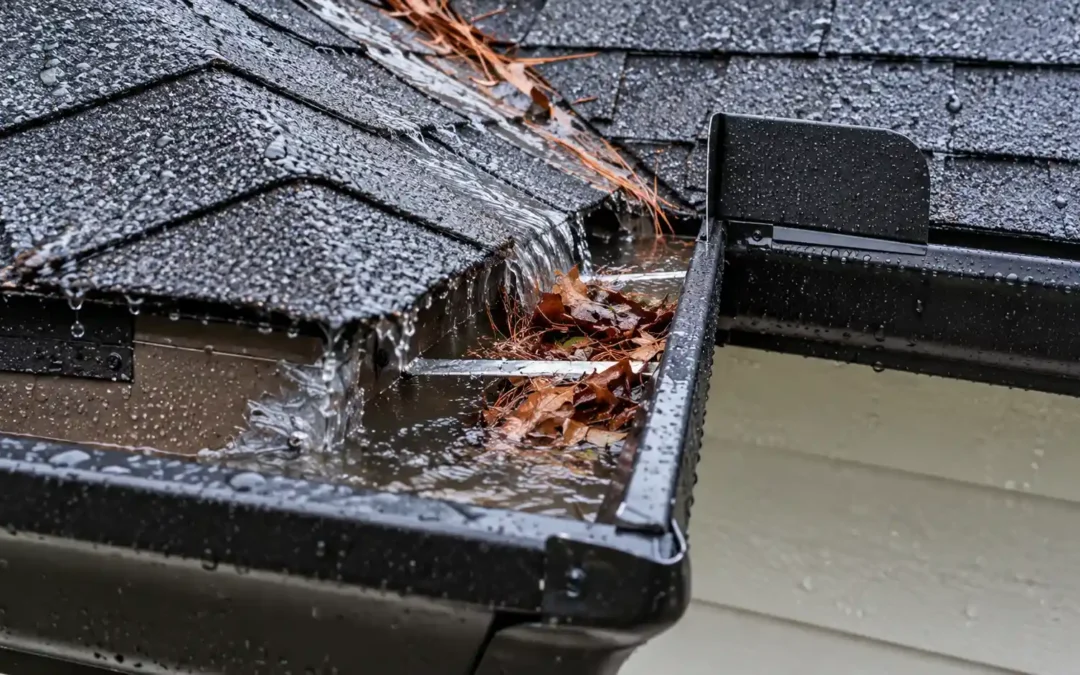
Gutter overflow in Houston is often more than a cleaning problem. During intense Gulf Coast downpours, runoff can exceed the drainage capacity of a poorly sized or configured system. Common causes include clogged downspout outlets, incorrect gutter pitch, concentrated roof-valley runoff, undersized gutters or downspouts, sagging sections, and roof-edge details that allow water to travel behind the gutter instead of into it.
That explains one of the most frustrating situations for homeowners: the gutters were just cleaned, yet the next Houston thunderstorm turns part of the roofline into a waterfall.
The reason is simple. A gutter system does more than catch water. Its hydraulic capacity depends on the roof area, roof pitch, valleys, gutter size, slope, downspout capacity, and where the discharged water ultimately goes.
In Houston, The Woodlands, Spring, Katy, Cypress, Sugar Land, Kingwood, and surrounding Southeast Texas communities, those details become especially important during short periods of intense rainfall.
The 7 Reasons Your Houston Gutters Overflow During Heavy Rain
1. Clogged Downspout Outlets and Elbow Traps
A gutter can look perfectly clean from the ground and still have a restricted downspout.
Leaves, pine needles, shingle granules, seed pods, and small debris tend to collect around the outlet where the gutter transitions into the downspout. Debris can also become trapped inside downspout elbows.
Once that outlet becomes restricted, water enters the gutter faster than it can leave.
The gutter begins filling from the outlet backward until water spills over the front or rear edge.
This is why gutters overflowing even when clean should be inspected beyond the visible horizontal trough. The outlets, elbows, and discharge points matter just as much.
2. Incorrect Gutter Pitch or Slope
Gutters are not supposed to be perfectly level.
They need a controlled slope toward the downspouts so gravity continuously moves water out of the system. A commonly used starting point is approximately 1/4 inch of fall for every 10 feet of gutter, although the correct pitch can vary with the length and configuration of the run.
If a section back-slopes or develops a low spot, water remains in the gutter after the storm.
That standing water consumes part of the gutter’s available capacity before the next heavy rainfall even begins.
Look for:
- Water remaining in gutters long after rain stops
- Overflow concentrated in the middle of a run
- One end draining while another remains full
- Visible low spots or uneven gutter lines
Correcting gutter drainage problems in Houston sometimes requires realignment rather than cleaning or complete replacement.
3. Roof Valley Water Torrents
Roof valleys are one of the most common places to see dramatic overflow.
A valley collects runoff from two adjoining roof planes and concentrates it into a relatively narrow path. On a steep or large roof, that water can reach the gutter with considerable velocity.
Instead of dropping neatly into the trough, the runoff may shoot across an inside corner or over the front edge.
That is why a gutter overflowing at a roof valley does not automatically mean the entire gutter system is too small.
The solution may involve evaluating the valley angle, gutter placement, capacity at the inside corner, and whether an appropriately designed valley splash guard can help redirect fast-moving runoff into the gutter.
The goal is not simply to build a taller wall. Water still needs a clear path into and through the drainage system.
4. Undersized 5-Inch Gutters Facing Houston Downpours
Many homes have traditional 5-inch gutters, and a properly designed 5-inch system can work well in the right application.
But gutter size should match the roof rather than being selected by habit.
A large roof area, steep pitch, long gutter run, or multiple roof planes draining toward one section can produce more runoff than a smaller system can efficiently manage during intense rainfall.
This is where 6-inch gutters for heavy rain may make sense.
TXN Home Services commonly installs custom 6-inch seamless .032 aluminum gutters when the roof and drainage conditions justify the additional capacity.
However, bigger is not automatically better.
A 6-inch gutter connected to inadequate downspouts or installed with poor pitch can still overflow. Roof area, rainfall intensity, valleys, gutter length, downspout location, and ground drainage all need to be considered together. مراجعة محتوى المقالات
5. Restricted Downspout Capacity
Think of the gutter as a reservoir and the downspouts as its drains.
Increasing gutter capacity without providing enough drainage capacity can simply create a larger reservoir.
A standard 2×3-inch downspout has less cross-sectional area than a 3×4-inch downspout. On high-volume sections, larger 3×4 downspouts can help move more water out of the gutter and reduce bottlenecks.
Location matters too.
One downspout at the end of a very long run may be less effective than a drainage layout designed around how water actually reaches the gutter.
During an inspection, we look at both sides of the equation:
How quickly is water entering the gutter, and how efficiently can the system discharge it?
6. Sagging Sections and Loose Hangers
A gutter that originally drained correctly can develop problems over time.
Repeated water weight, debris accumulation, thermal movement, aging fasteners, or deterioration of the fascia can allow sections to sag or pull away from the roofline.
Older spike-and-ferrule systems may loosen over time, while improperly spaced or failing hangers can allow low spots to develop.
Those low sections hold water.
During the next storm, they fill first and overflow before the rest of the system reaches capacity.
Hidden fascia damage is especially important here. Installing another fastener into deteriorated wood may not correct the underlying problem.
The fascia condition needs to be evaluated before reinforcement or replacement is recommended.
7. Water Is Sneaking Behind the Gutter
Not every apparent gutter overflow is actually water coming over the front.
Sometimes water is traveling behind the gutter.
The roof edge, shingles, drip edge, fascia, and gutter position need to work together so runoff leaves the roof and enters the trough.
If the roof-edge detail is damaged, incorrectly integrated, or leaves an unintended water path, surface tension and capillary action can allow water to track behind the gutter.
Over time, repeated moisture exposure may contribute to staining or deterioration of wood fascia and soffit materials.
Simply replacing the gutter without identifying that water path may leave the original problem unresolved.
Gutter Overflow Diagnostic Table
| Symptom | Most Likely Cause | Potential Hidden Damage | Professional Correction to Evaluate |
|---|---|---|---|
| Waterfall near downspout | Clogged outlet or elbow | Fascia moisture, soil erosion | Clear and inspect outlet/downspout |
| Overflow in middle of run | Low spot or incorrect pitch | Standing water, stressed hangers | Re-pitch and reinforce gutter |
| Water shooting over inside corner | Concentrated valley runoff | Fascia/soffit moisture, erosion | Evaluate valley, capacity and splash guard |
| Entire run overflows | Capacity or drainage bottleneck | Concentrated water around perimeter | Evaluate gutter and downspout sizing |
| Water behind gutter | Roof-edge/drip-edge problem | Hidden fascia deterioration | Correct roof-edge water path |
| Gutter visibly sagging | Loose hangers or fascia damage | Fascia deterioration | Inspect fascia and fastening system |
| Gutter fills but drains slowly | Restricted/undersized downspout | Repeated overflow and pooling | Evaluate outlet and downspout capacity |
Gutters Overflowing Even When Clean? The Houston Heavy-Rain Reality
Cleaning solves debris-related restrictions. It does not correct hydraulic-capacity or installation problems.
A clean gutter can still overflow because of improper pitch, concentrated valley runoff, insufficient downspouts, inadequate gutter size, sagging, or incorrect roof-edge integration.
For homes where additional capacity is appropriate, one solution may be a custom 6-inch seamless .032 aluminum gutter system paired with 3×4 downspouts.
Gutter protection may also help address debris.
TXN installs LeafBlaster Pro® stainless steel micro-mesh gutter protection, which is designed to help keep leaves, pine needles, roof grit, and other debris out while allowing rainwater into the gutter.
It is important to understand what gutter protection does—and what it does not do.
A gutter guard does not correct an improperly pitched gutter, deteriorated fascia, inadequate downspout layout, or an undersized drainage design. Existing gutters may need cleaning, realignment, reinforcement, repair, or replacement before gutter protection is installed. مراجعة محتوى المقالات
The best gutter overflow protection in Houston therefore starts with diagnosing why the water is overflowing.
Frequently Asked Questions About Gutter Overflow in Houston
Why do my gutters overflow even though they were just cleaned?
The restriction may be inside a downspout or elbow, or the problem may have nothing to do with debris. Incorrect pitch, sagging, concentrated roof-valley runoff, insufficient downspout capacity, or an undersized gutter can all cause clean gutters to overflow.
Can gutter overflow cause foundation problems in Houston?
Repeated roof runoff concentrated beside a home can contribute to soil erosion, ponding, and changes in moisture conditions around the perimeter. Houston-area expansive soils make drainage management important, but gutters alone cannot guarantee against foundation movement. Downspout discharge and overall site drainage also need to be considered.
Will installing 6-inch gutters completely stop overflow during heavy rain?
No gutter size can honestly be promised to prevent overflow under every storm condition. A properly designed 6-inch system provides additional capacity, but performance also depends on roof area, pitch, valleys, gutter slope, downspout size and placement, debris, and rainfall intensity.
How do I stop water from shooting over the gutter at roof valleys?
First determine whether the problem is water velocity, gutter position, insufficient capacity, or the geometry of the inside corner. Depending on the roof, a properly positioned valley splash guard may help redirect runoff, but the entire drainage path should be evaluated before adding one.
Can overflowing gutters rot the wood behind them?
Repeated moisture exposure can contribute to fascia and soffit deterioration. Overflowing gutters are one possible source, but roof leaks, failed sealant, roof-edge drainage problems, flashing issues, and other moisture sources can produce similar damage. The cause should be confirmed during inspection. مراجعة محتوى المقالات
Schedule a Comprehensive Roofline & Drainage Evaluation
Solving gutter overflow in Houston requires more than looking inside the gutter.
A proper evaluation should examine the roof area and pitch, valley locations, gutter size and slope, downspout capacity and placement, fascia condition, hangers, roof-edge and drip-edge integration, discharge locations, and how water moves away from the house.
TXN Home Services provides professional gutter and roofline evaluations throughout Greater Houston and Southeast Texas.
Our team is professionally trained, insured, and experienced with seamless gutter systems, roofline water management, fascia and soffit repair, gutter protection, and roofing.
Not sure why your gutters overflow during heavy rain?
Contact TXN Home Services to schedule a free gutter and roofline inspection and custom estimate.
Call or text: 346-460-9199
Website: TXNHomeServices.com
Built to last. Proven to protect.
