
Attic Ventilation in Houston: What Homeowners Need to Know About Heat, Moisture & Airflow
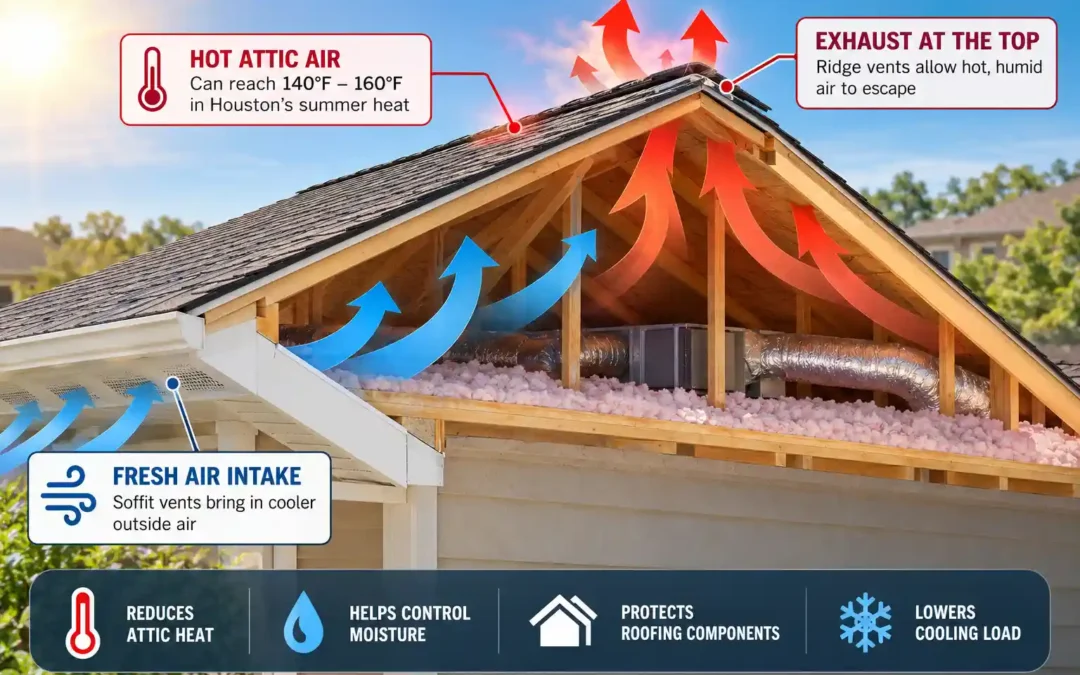
Proper attic ventilation in Houston depends on balanced airflow: fresh outside air enters low through soffit intake vents while hot, humid attic air exits high through ridge vents or a properly designed powered exhaust system. In Houston’s climate, this airflow helps reduce extreme attic heat and moisture buildup, limits heat stress on roofing components, and reduces the cooling load created by superheated attic spaces.
Houston homeowners often notice the symptoms before they think about ventilation: the second floor stays noticeably warmer, the air conditioner seems to run constantly, or the attic feels like an oven even after the sun begins to set.
The important point is that attic ventilation is a system, not simply a collection of roof vents. More vents do not automatically mean better ventilation. The intake, exhaust, roof geometry, insulation, and available Net Free Area (NFA) all need to work together.
That is particularly important for homes throughout Houston, The Woodlands, Spring, Katy, Cypress, Sugar Land, Kingwood, and Southeast Texas, where prolonged heat and Gulf Coast humidity can place significant stress on both roofing systems and HVAC equipment.
Why Houston Attics Can Reach 150°F+ — The Physics of Heat and Humidity
On a sunny Houston afternoon, asphalt shingles absorb solar radiation. Heat moves through the roofing materials and roof decking and radiates into the attic below.
Under severe summer conditions, poorly ventilated attics can become dramatically hotter than the outdoor air, sometimes reaching temperatures in the 140°F–160°F range. But there is no single temperature that defines a ventilation failure; roof color, orientation, insulation, shading, air sealing, ventilation design, and outdoor conditions all affect attic temperature.
The problem is not simply that the attic feels hot.
Radiant Heat and HVAC Load
Heat stored in the roof deck and attic can transfer toward the ceiling and conditioned areas below. If HVAC ducts or air-handling components run through the attic, they are also operating inside that hot environment.
That can contribute to HVAC duct heat gain and additional cooling demand. Balanced ventilation helps reduce attic heat buildup, but it should work alongside proper insulation and air sealing—not be treated as a substitute for either.
Houston Humidity Adds Another Variable
Moisture is the second half of the equation.
Humid outdoor air, indoor air leakage, bathroom exhaust problems, duct leakage, and other moisture sources can affect attic relative humidity. When moisture encounters sufficiently cool surfaces, vapor condensation can occur.
Repeated or prolonged moisture exposure can contribute to rusty fasteners, damp insulation, staining, microbial growth, or deterioration of roof decking.
That is why effective Houston attic ventilation needs to address both heat and moisture management.
The Golden Rule: Intake vs. Exhaust
A properly vented attic needs two things:
- Intake ventilation near the bottom of the roof, typically through soffits or eaves.
- Exhaust ventilation near the highest practical point, such as a continuous ridge vent or properly designed power vent.
As warm attic air rises and exits high on the roof, replacement air enters through the lower intake vents. This creates the intended airflow path through the attic.
Owens Corning describes the basic design as an approximate 1:1 intake-to-exhaust relationship and notes that having slightly more intake than exhaust can be preferable.
Understanding Net Free Area (NFA)
Vent size alone does not tell us how much ventilation it provides.
Net Free Area, or NFA, represents the actual unobstructed opening available for air movement after accounting for screens, louvers, and the vent’s construction.
A common calculation is the 1:300 ventilation rule: approximately one square foot of NFA for every 300 square feet of attic floor area under qualifying configurations. Building-code requirements can vary by assembly and conditions; the IRC also contains a 1:150 baseline with an exception permitting 1:300 when specified requirements are satisfied.
This is why attic ventilation should be calculated rather than estimated by counting vents from the driveway.
Your Soffit Vents May Exist but Still Not Work
One problem we encounter is an attic that appears to have plenty of soffit ventilation from outside but has restricted airflow inside.
Blown-in insulation can cover the openings at the eaves.
Baffles or rafter vents create an air channel above the insulation so air can move from the soffit into the attic. Owens Corning specifically describes rafter vents as maintaining unrestricted airflow from soffits through areas containing fibrous or loose-fill insulation.
A roof can therefore have adequate exhaust on paper and still perform poorly because the intake side is blocked.
Why More Roof Vents Are Not Always Better
One of the biggest mistakes in roof ventilation Houston projects is adding another exhaust vent without evaluating the existing system.
Suppose a home already has a continuous ridge vent. Adding a powered attic fan below that ridge does not automatically improve the system.
The powered vent needs replacement air. If adequate soffit intake is unavailable, it may pull air from easier openings—including other roof vents or potentially leakage paths between the conditioned home and attic.
That can short-circuit the intended soffit-to-ridge airflow pattern.
The better approach is to determine what exhaust strategy fits the roof and then provide sufficient low intake to support it.
Ridge Vent vs. Power Vent: Which Works Better for Houston Homes?
There is no universal answer to ridge vent vs power vent Houston searches. Roof geometry matters.
Continuous Ridge Vents
A ridge vent provides passive exhaust along the roof’s upper ridge.
On a roof with a long, usable ridge and adequate continuous soffit ventilation, it can create an effective low-to-high airflow path without a motor.
Quality ridge vent systems may also incorporate external baffles and weather-infiltration protection. For example, Lomanco lists exterior wind baffles and weather-infiltration protectors among features of its VUR-10 ridge vent. Lomanco
Lomanco Power Vents
Some hip roofs, complicated rooflines, or attics with limited usable ridge length may require a different design.
A properly sized Lomanco power vent can provide mechanically driven exhaust. The Lomanco 2000TH, for example, uses an adjustable thermostat/humidistat combination control, allowing operation to respond to attic temperature and moisture conditions.
But powered exhaust still requires intake. Lomanco specifically warns that inadequate intake can cause power-vent problems and recommends checking that insulation has not blocked intake openings.
| Feature | Continuous Ridge Vent | Lomanco Power Vent |
|---|---|---|
| Air movement | Passive / natural | Mechanically powered |
| Best fit | Roofs with adequate usable ridge | Hip/complex roofs or limited ridge configurations |
| Intake required | Yes | Yes |
| Electricity | None | Required for electric models |
| Moving components | None | Motor/control components |
| Control | Natural airflow | Thermostat/humidistat options |
| Storm design | Baffles/weather protection vary by product | Product-specific rain shield/weather protection |
| Maintenance | Generally limited | Motor and controls should be checked |
The best attic ventilation for Houston homes is therefore not automatically ridge ventilation or powered ventilation. It is the system that provides an appropriate, balanced airflow path for that particular attic and roof.
Warning Signs Your Houston Attic May Have a Ventilation Problem
No single symptom proves that ventilation is the cause. Insulation, ductwork, HVAC performance, roof leaks, and air sealing can produce similar symptoms.
However, several conditions justify a closer inspection:
- A second floor that remains substantially hotter than the first.
- Extremely high attic temperatures combined with poor airflow.
- HVAC equipment running for unusually long periods.
- Damp, compressed, or matted attic insulation.
- Condensation or corrosion on roofing nails.
- Staining or moisture on the underside of roof decking.
- Warped or deteriorated decking.
- Soffit vents covered by insulation.
- Exhaust vents with little or no corresponding intake.
- Premature deterioration of roofing components.
Peeling or blistering interior paint can also indicate moisture, but the source should be diagnosed rather than automatically blamed on attic ventilation.
Frequently Asked Questions About Attic Ventilation in Houston
How hot should an attic get during a Houston summer?
There is no universal maximum temperature because attic conditions vary with outdoor temperature, roof color, sun exposure, insulation, ventilation, and roof design. During extreme Houston summer conditions, some poorly ventilated attics can reach roughly 140°F–160°F. The more useful diagnostic is often how far the attic temperature rises above outdoor conditions and whether the ventilation system has a clear intake-to-exhaust path.
Can adding more roof vents actually hurt attic airflow?
Yes, improperly adding exhaust vents can disrupt the intended airflow pattern. Multiple exhaust types may compete for intake air or pull from each other. The better approach is to calculate NFA and balance intake with one appropriately designed exhaust strategy.
Do ridge vents let rain in during Houston tropical storms?
A properly installed, quality ridge vent is designed to resist weather infiltration, but no roof component should be described as incapable of leaking under every condition. Product design, external baffles, roof pitch, installation, flashing, and extreme wind-driven rain all matter. Some ridge vents specifically incorporate wind baffles and weather-infiltration protection. Lomanco
Can improving attic ventilation lower my electric bill?
It can help reduce cooling strain by limiting excessive attic heat buildup, particularly when HVAC ducts are located in the attic. However, ventilation alone cannot guarantee lower electric bills. Insulation levels, duct leakage, HVAC efficiency, thermostat settings, windows, air sealing, and occupant behavior also influence energy use.
Do I need soffit vents if I already have a roof ridge vent?
A ridge vent needs adequate intake to work as intended. Continuous soffit ventilation is a common way to provide that low intake. If insulation blocks those openings, baffles or rafter vents may be needed to maintain the airflow channel.
Schedule a Comprehensive Roofline & Ventilation Evaluation
A proper attic ventilation Houston evaluation should go beyond counting vents on the roof.
The attic floor area, roof geometry, existing Net Free Area, usable ridge length, soffit intake, insulation placement, baffles, existing exhaust vents, roof decking condition, and potential moisture sources should all be evaluated before recommending changes.
TXN Home Services is a professionally trained, insured Owens Corning Preferred Contractor and Lomanco Certified Ventilation Contractor, serving Greater Houston and Southeast Texas.
If your second floor stays unusually hot, your attic shows signs of moisture, or you are unsure whether your current intake and exhaust are properly balanced, we can inspect the roofline and attic ventilation system and explain the available options.
TXN Home Services
Call or text: 346-460-9199
Website: TXNHomeServices.com
Built to last. Proven to protect.
