
Micro-Mesh vs. Reverse-Curve Gutter Guards: Which Works Better for Houston Homes?
Micro-mesh and reverse-curve gutter guards manage water differently. Micro-mesh uses fine stainless-steel filtration to help block pine needles, leaves, and shingle grit while admitting runoff through the screen. Reverse-curve systems rely on liquid adhesion and surface tension to guide water around a curved hood into a narrow opening. During high-velocity runoff, either system’s performance depends heavily on roof geometry, valleys, gutter capacity, and installation.
For Houston homeowners, choosing gutter protection is not simply about keeping leaves out. A system also needs to work with the home’s roof pitch, gutter size, downspouts, surrounding trees, and the concentrated runoff created by roof valleys.
That matters throughout Houston, The Woodlands, Kingwood, Spring, Conroe, and other heavily wooded areas of Southeast Texas, where pine needles, oak leaves, pollen, roof grit, and sudden heavy rain can all reach the roofline.
Understanding micro mesh vs reverse curve gutter guards starts with understanding the very different physics behind them.
How They Work: Surface Tension vs. Physical Filtration
Reverse-Curve Gutter Guards: Using Surface Tension
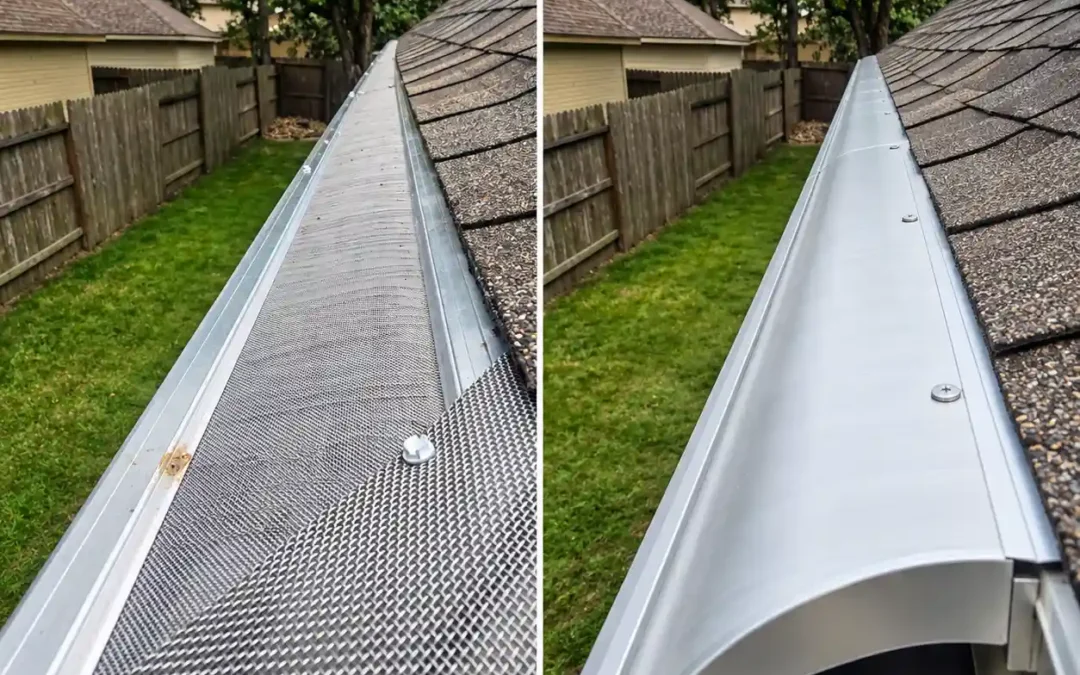
Reverse-curve systems—sometimes called surface-tension or helmet-style gutter guards—typically cover most of the gutter with a solid hood.
Rainwater travels across the hood toward a rounded front edge. Because water molecules adhere to the surface, the system attempts to guide the runoff around the curve and through an opening into the gutter below.
Larger leaves and debris are intended to continue past the opening and fall away.
This approach can work under appropriate conditions, but performance depends on the speed and volume of runoff, cleanliness of the curved surface, roof pitch, installation angle, and geometry of the roofline.
The opening also remains large enough that some small debris can potentially enter the gutter.
Micro-Mesh: Physical Filtration
Micro-mesh uses a different approach.
Instead of asking water to follow a curved surface into an opening, a porous metal screen covers the gutter. Water passes through the openings while debris remains primarily above the screen.
LeafBlaster Pro® Stainless Steel Micro-Mesh, for example, uses a stainless-steel filtration surface designed to keep small and large debris from entering the gutter. Its standard stainless-steel system includes a 30-mesh option, while a more open 14-mesh configuration is available for high-flow applications. LeafBlaster Pro
That distinction matters because generic claims such as “30-to-50 mesh” or “304/316 marine-grade stainless steel” should not automatically be applied to every micro-mesh product. Product specifications vary by manufacturer.
Performance in Heavy Texas Rain: Surface Tension vs. High-Velocity Runoff
The biggest challenge for any gutter protection Houston system is not ordinary rainfall. It is concentrated runoff.
A steep roof moves water differently from a shallow roof. A large roof plane sends more water toward the gutter than a small one. And a roof valley can combine runoff from two slopes into one high-velocity stream.
Can Water Overshoot a Reverse-Curve Guard?
It can.
A reverse-curve system depends on the incoming water maintaining sufficient contact with the curved surface to follow it toward the collection slot.
As runoff velocity increases, some water may continue outward instead of following the curve. Roof valleys and steep pitches can make this more challenging because the water reaches the guard with greater concentrated momentum.
That does not mean reverse-curve guards always overflow. Installation, system design, roof geometry, and rainfall conditions matter.
What About Micro-Mesh?
Micro-mesh allows water to enter across a much broader portion of the gutter’s covered surface rather than primarily through a front collection slot.
However, micro-mesh is not immune to overflow either.
Very high runoff volume, an improperly installed guard, accumulated organic material on the screen, an undersized gutter, a restricted downspout, or concentrated valley flow can still overwhelm the system.
LeafBlaster Pro’s own installation instructions emphasize eliminating gaps at the gutter lip and maintaining proper mesh positioning to help prevent runoff from traveling over the front. LeafBlaster Pro
This is why the best gutter guards for Houston cannot be selected independently of the gutter system underneath them.
The Debris Factor: Oak Leaves, Pine Needles and Houston Roof Grit
Pine Needles
Pine needles are particularly relevant in The Woodlands, Kingwood, Spring, and Conroe.
Their narrow shape makes them difficult for gutter-protection systems with larger openings. Individual needles can sometimes enter openings that easily reject full-sized leaves.
A fine micro-mesh barrier provides a smaller physical pathway for debris.
LeafBlaster Pro specifically identifies its Frame-Reinforced Stainless Steel Micro-Mesh product for properties surrounded by mature trees such as pine and oak, while its stainless-steel micro-mesh systems are designed to filter small and large debris. LeafBlaster Pro
That makes gutter guards for pine needles a different design problem from simply stopping large leaves.
Shingle Grit and Pollen
As asphalt roofs age, small mineral granules can wash toward the gutters. Pollen, seeds, organic particles, and decomposed leaf material may arrive with them.
Micro-mesh can help prevent much of this material from entering the gutter, although very fine material may settle on the surface and occasionally require cleaning.
A reverse-curve system has a larger collection opening, so smaller material that follows the water around the nose may enter the gutter.
Insects and Small Pests
An enclosed reverse-curve system can create protected spaces around openings or underneath the hood. Depending on the design and installation, insects such as wasps may occasionally find suitable nesting areas.
Micro-mesh minimizes large open entry points across the top of the gutter, although no gutter guard should be marketed as making an entire roofline pest-proof.
Comparison: Micro-Mesh vs. Reverse-Curve Gutter Guards
| Factor | Micro-Mesh | Reverse-Curve |
|---|---|---|
| Operating principle | Physical filtration through fine mesh | Liquid adhesion / surface tension |
| Water entry | Across porous mesh surface | Around curved nose into opening |
| Heavy runoff | Good potential when correctly sized and installed; extreme flow can still overwhelm it | High-velocity runoff can sometimes overshoot curved edge |
| Pine needles | Fine mesh helps block needle entry | Narrow debris may enter collection opening |
| Shingle grit | Helps filter small particles | Fine material can follow water through opening |
| Roof valleys | May require high-flow detailing depending on runoff | Concentrated runoff may require additional management |
| Installation | Product-specific; roofline or below-roofline configurations available | Often uses brackets/support structure depending on manufacturer |
| Maintenance | Surface debris may occasionally need removal | Interior debris may require access beneath hood |
| Visibility | Typically low profile | Often more visible because of solid hood |
| Best application | Fine debris and mixed tree environments | Properties where the particular roof/system suits surface-tension design |
Neither technology should be sold as maintenance-free forever.
The better question is: Which design fits the roof, debris load, rainfall exposure, and existing gutter system?
Roof Warranty and Installation Differences
Installation deserves as much attention as the guard itself.
Some gutter protection products are designed to slide under a shingle course. Others use fascia mounts, gutter-lip attachment, or other configurations.
Carelessly lifting adhered shingles or interfering with the self-sealing strip can potentially affect the roofing assembly. Whether a particular installation affects warranty coverage depends on the roofing manufacturer, product, roof condition, and installation method; homeowners should not assume that every under-shingle guard automatically voids a roof warranty.
LeafBlaster Pro is a good example of why installation claims need to be precise.
Its standard Stainless Steel Micro-Mesh installation guide allows the rear rail to slide beneath shingles in compatible roof configurations, but specifically directs installers to use a below-roofline method when roofing material is adhered in a way that makes the standard method unsuitable. That alternative bends and secures the guard at the fascia. LeafBlaster Pro
The Frame-Reinforced product likewise provides both a standard under-shingle configuration and a below-roofline installation using a fascia mount. LeafBlaster Pro
So it would be inaccurate to claim that LeafBlaster Pro always installs without going beneath shingles.
A professional installer should select the configuration appropriate for that particular roof rather than forcing one mounting method onto every home.
LeafBlaster Pro Original vs. Frame-Reinforced
TXN Home Services installs both LeafBlaster Pro® Stainless Steel Micro-Mesh and LeafBlaster Pro® Frame-Reinforced Stainless Steel Micro-Mesh.
The standard stainless-steel micro-mesh system provides a combination of filtration and flexibility for many residential installations.
Frame-Reinforced adds a T-6 treated aluminum supporting frame beneath the stainless-steel mesh, providing greater rigidity and load-bearing strength. LeafBlaster Pro positions the Frame-Reinforced product for demanding applications, including homes surrounded by mature pine and oak trees. LeafBlaster Pro
The right product still depends on the property rather than simply choosing the most substantial version.
Frequently Asked Questions
Can water overshoot reverse-curve gutter guards during heavy Houston rain?
Yes, it can under certain conditions. Surface-tension systems rely on water remaining attached to a curved surface. High-velocity runoff from steep roof sections or concentrated valleys can sometimes travel past the collection opening. Proper sizing and installation can improve performance, but no system should be promised to capture every drop during every storm.
Are micro-mesh gutter guards good for homes with pine trees?
They can be particularly useful because fine mesh creates a physical barrier against narrow pine needles and other small debris. LeafBlaster Pro specifically identifies its Frame-Reinforced micro-mesh product as suitable for homes around mature pine and oak trees. LeafBlaster Pro
Will installing gutter guards void my roof warranty?
Not automatically. It depends on the roofing product and installation method. Guards that require manipulating shingles should be installed according to applicable roofing and gutter-guard manufacturer requirements. Below-roofline or fascia-mount configurations may be preferable when shingles should not be disturbed.
Do micro-mesh gutter guards ever need cleaning?
Yes. Micro-mesh is a lower-maintenance gutter protection solution, not a maintenance-free one. Pollen, leaves, pine needles, organic material, or roof debris can occasionally accumulate on the surface and may need brushing or cleaning. The goal is to reduce debris entering the gutter and reduce cleaning frequency—not eliminate maintenance forever. مراجعة محتوى المقالات
Can LeafBlaster Pro be installed on existing gutters?
Yes, when the existing gutter system is suitable. Before installation, the gutters should be inspected for cleanliness, pitch, leaks, alignment, attachment, fascia condition, and drainage capacity. LeafBlaster Pro’s installation instructions themselves begin with cleaning and repairing the existing gutters. LeafBlaster Pro
Schedule a Comprehensive Roofline & Gutter Protection Evaluation
Choosing between micro mesh vs reverse curve gutter guards should begin with the house—not the product brochure.
Tree density, pine-needle exposure, roof pitch, valleys, gutter size, downspout capacity, fascia condition, gutter alignment, roof-edge configuration, and accessibility all influence the appropriate system and project scope.
TXN Home Services is a professionally trained, insured, Elite LeafBlaster Pro Contractor serving Greater Houston and Southeast Texas.
We can inspect the existing gutters and roofline, explain what we find, and determine whether the gutters need cleaning, resealing, realignment, reinforcement, repair, or replacement before gutter protection is installed.
TXN Home Services
Call or text: 346-460-9199
Website: TXNHomeServices.com
Built to last. Proven to protect.
