
Do Gutter Guards Really Work? What Greater Houston Homeowners Should Know
Homes surrounded by oak and pine trees can fill open gutters with leaves, pine needles, seed pods, roof grit, and shingle granules surprisingly quickly. Add the intense downpours common across Greater Houston, and a partially blocked gutter can overflow before a homeowner realizes there is a problem.
So, do gutter guards really work, or are they simply another exterior home product with unrealistic marketing claims?
The honest answer is that a properly selected and professionally installed gutter guard can significantly reduce the amount of debris entering the gutter trough. However, gutter guards do not repair undersized gutters, poor gutter pitch, blocked downspouts, or damaged fascia. They also do not eliminate every cleaning or inspection.
The value of gutter guards for Greater Houston homes depends on the guard design, surrounding trees, rainfall intensity, existing gutter condition, and quality of installation.
How Do Gutter Guards Work? The Mechanics of Gutter Protection
To understand how do gutter guards work, start with their basic engineering purpose: allow roof runoff to enter the gutter while filtering or redirecting solid debris.
A gutter guard covers the open gutter trough and creates controlled water-entry points. Depending on the design, water may pass through small mesh openings, perforations, or around a curved surface. Leaves and other debris are intended to remain above the system, where wind, gravity, or occasional surface cleaning can remove them.
Effective performance depends on several factors:
- The size of the mesh aperture or openings
- The speed and volume of roof runoff
- Roof pitch and roof area
- Water concentrated by roof valleys
- Gutter pitch and alignment
- Downspout outlet capacity
- Nearby tree density
- The guard’s installation angle
- Its ability to support debris shedding
Some designs rely primarily on filtration. Others use surface tension to direct water into the gutter while carrying debris beyond the edge. Neither principle works perfectly under every roof and storm condition.
The Gutter Guards Pros and Cons: A Realistic Assessment
Understanding the gutter guards pros and cons helps homeowners set realistic expectations before investing in a system.
The Main Advantages
A properly designed guard can provide several practical benefits.
Reduced debris inside the gutter:
Guards can help keep out oak leaves, pine needles, seed pods, small branches, and other organic debris that commonly creates clogs.
Fewer full gutter cleanings:
Homeowners may still need periodic surface maintenance, but removing material from the top of a guard is often easier than extracting compacted debris from inside a gutter.
Lower risk of debris-related overflow:
Keeping outlets and gutter channels clearer can help lower the risk of water spilling over the gutter during moderate and heavy rain.
Better access for difficult rooflines:
Two-story homes and steep rooflines can be difficult and unsafe for homeowners to maintain. Gutter guards may reduce how often full interior cleaning is needed.
Less moisture trapped inside gutters:
Wet leaves sitting inside the trough can contribute to staining, corrosion, joint failure, and unnecessary weight on hidden hangers. Reducing this accumulation can help preserve the gutter system’s condition.
The Main Limitations
The biggest limitation is simple: gutter guards do not remove the need for all maintenance.
Pollen buildup, sap, fine roof grit, shingle granules, and miniature seed pods may collect on the surface. Organic material can also become trapped around roof valleys, inside corners, and splash guards.
Other potential downsides include:
- Upfront installation cost
- Poor performance from an unsuitable design
- Water overshooting during intense runoff
- More difficult access when repairs are needed
- Problems caused by improper installation
- Continued need for periodic inspection
When homeowners ask are gutter guards worth it, the answer depends on how often the gutters currently clog, how difficult they are to access, and whether the selected guard matches the property’s debris and drainage conditions.
Comparing the Main Types of Gutter Guards Available
There are several types of gutter guards, and they do not all filter debris or manage water in the same way.
Stainless Steel Micro-Mesh Gutter Guards
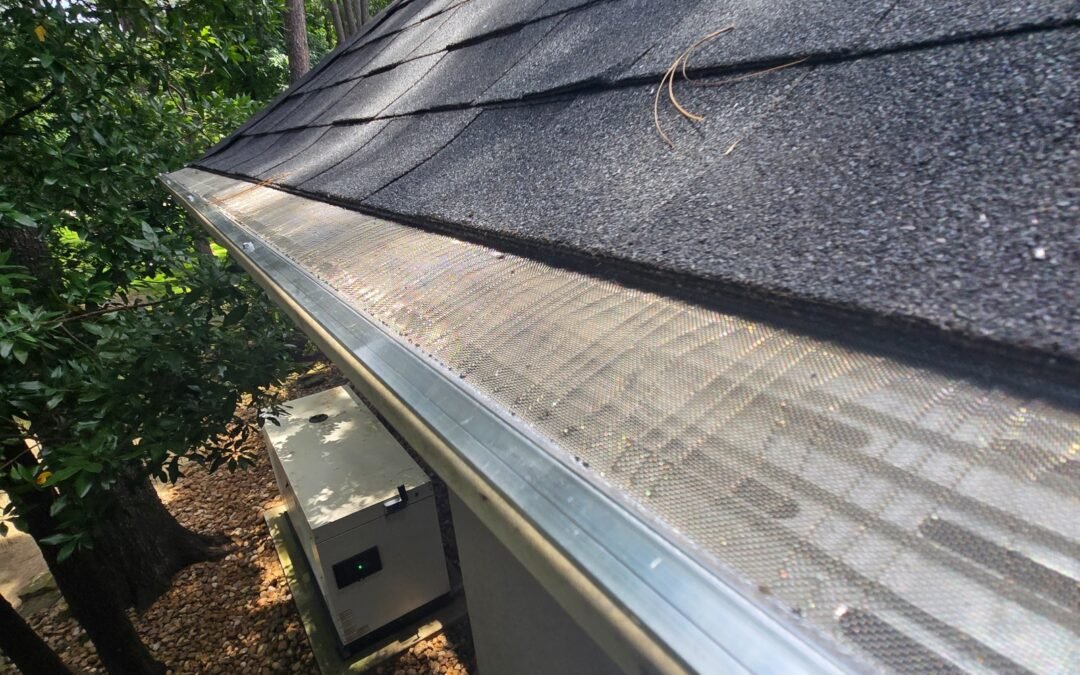
Micro-mesh gutter guards use very small openings to help block fine material while allowing rainwater to pass through. A quality system typically combines stainless steel micro-mesh with a rigid support frame.
This design is particularly useful for filtering:
- Pine needles
- Small oak leaves
- Seed pods
- Roof grit
- Shingle granules
- Fine organic debris
Frame-reinforced systems help prevent the mesh from collapsing under debris or separating from the support structure. The installation angle also affects water entry and debris shedding.
LeafBlaster Pro® uses stainless steel micro-mesh and is available in configurations that include frame-reinforced support. Homeowners researching LeafBlaster Pro in Greater Houston should still have the existing gutters inspected before installation. The product performs best over clean, properly aligned, structurally sound gutters.
Screens and Perforated Aluminum Guards
Standard screens and perforated aluminum guards contain larger openings than micro-mesh systems. They can block larger oak leaves and branches while allowing water into the gutter.
Their advantages include simpler construction and lower entry cost. However, pine needles, roof grit, small seeds, and shingle granules may pass through or become lodged in the openings.
These systems may be adequate for homes with larger leaves and limited fine debris, but they usually provide less filtration than stainless steel micro-mesh.
Reverse-Curve Gutter Guards
A reverse-curve design uses surface tension. Rainwater follows a curved edge into the gutter, while leaves are intended to fall beyond the opening.
These systems can shed larger debris effectively when the leading edge remains clean and the water approaches at the expected speed. Their performance may vary under concentrated roof runoff, steep roof slopes, or heavy water volume below roof valleys.
Small debris may also enter through the water opening, and buildup along the curved edge can affect water adhesion.
Foam Inserts
Foam inserts sit inside the gutter and allow water to pass through porous material while blocking larger debris.
They are easy to install, but fine material can settle into the foam. Moisture may remain trapped, and organic growth can develop when the inserts stay damp. Foam can also deteriorate under heat and ultraviolet exposure.
These characteristics make foam less attractive as a long-term professional solution.
Brush Inserts
Brush inserts use upright bristles to keep larger leaves above the gutter trough while allowing water to flow below.
They are simple to remove, but pine needles and small organic material can become tangled in the bristles. Cleaning the brushes may require removing and reinstalling them.
Brush systems generally reduce large debris but provide limited filtration against fine material.
Why Do Some Gutter Guard Systems Fail? Common Gutter Guard Problems
Many gutter guard problems are not caused by the guard alone. They result from installing protection over a gutter system that already has structural or drainage deficiencies.
Common failure points include:
- Incorrect gutter pitch: Water pools instead of flowing toward the downspout outlet.
- Sagging gutters: Weak or loose hidden hangers create low points and standing water.
- Undersized gutters: The gutter lacks sufficient drainage capacity for the contributing roof area.
- Blocked downspouts: A clear guard surface cannot overcome a restricted outlet or underground drain.
- Poor gutter alignment: Water passes behind or overshoots the gutter.
- Concentrated roof runoff: Roof valleys and inside corners direct excessive water toward a short section.
- Incorrect installation angle: Water moves across the guard faster than it can enter.
- Installation over dirty gutters: Existing debris remains trapped beneath the new system.
This is why guards should be installed only after the gutters have been cleaned, sealed, repaired, and realigned. The best gutter protection is still limited by the drainage system underneath it.
Debunking the Myth: Do Gutter Guards Really Work Without Maintenance?
No gutter protection system should be presented as fully self-cleaning.
Homeowners often ask, do gutter guards need maintenance or do gutter guards need cleaning after installation? The realistic answer to both questions is yes, although the frequency and difficulty of maintenance may be reduced.
Even quality micro-mesh can collect:
- Pollen
- Tree sap
- Roof grit
- Shingle granules
- Small seeds
- Pine straw
- Debris around roof valleys
Wind and rain may remove some surface material, but they will not remove everything under every condition. Tree density, roof geometry, rainfall intensity, and periods of dry weather all affect buildup.
Periodic inspection should include checking the guard surface, gutter alignment, downspout flow, inside corners, splash guards, and any area below a major roof valley.
Frequently Asked Questions
Do gutter guards really work?
Yes, properly selected guards can substantially reduce the amount of debris entering a gutter. Their performance depends on the guard type, nearby trees, roof runoff, rainfall intensity, gutter condition, and installation quality.
Are gutter guards worth it for Greater Houston homes?
They can be worthwhile for properties with heavy tree coverage, recurring clogs, difficult-to-access gutters, or frequent debris-related overflow. Whether gutter guards are worth it in Greater Houston depends on the home’s roofline and the type of debris surrounding it.
Do gutter guards eliminate gutter cleaning entirely?
No. They can reduce full interior cleaning, but surface debris, pollen, roof grit, and seed pods may still require periodic removal. Homeowners asking do gutter guards need cleaning should expect a lower-maintenance system, not a zero-maintenance system.
What type of gutter guard works best?
The right system depends on nearby debris and water volume. Stainless steel micro-mesh generally provides stronger filtration for pine needles and roof grit, while perforated screens may be sufficient for larger leaves. The existing gutter condition must also be considered when selecting the best gutter protection.
Why do some gutter guard systems fail?
Systems commonly fail because of improper installation, unsuitable product selection, blocked downspouts, poor gutter pitch, undersized gutters, sagging sections, or concentrated runoff from roof valleys.
Choosing the Right Solution for Your Home
The answer to do gutter guards really work is yes—with realistic expectations. They help reduce debris, clogs, and the frequency of full gutter cleaning, but they cannot correct a poorly designed or damaged drainage system.
Before installing micro-mesh gutter guards, the existing gutters should be evaluated for pitch, alignment, leaks, hanger strength, downspout capacity, and fascia condition.
TXN Home Services provides professional gutter and roofline evaluations throughout Greater Houston. As an Elite LeafBlaster Pro Contractor, our team can inspect the existing system and recommend a frame-reinforced micro-mesh solution when it is appropriate for the property.
Call or text 346-460-9199 or visit TXNHomeServices.com to schedule a free gutter inspection and gutter protection consultation.