
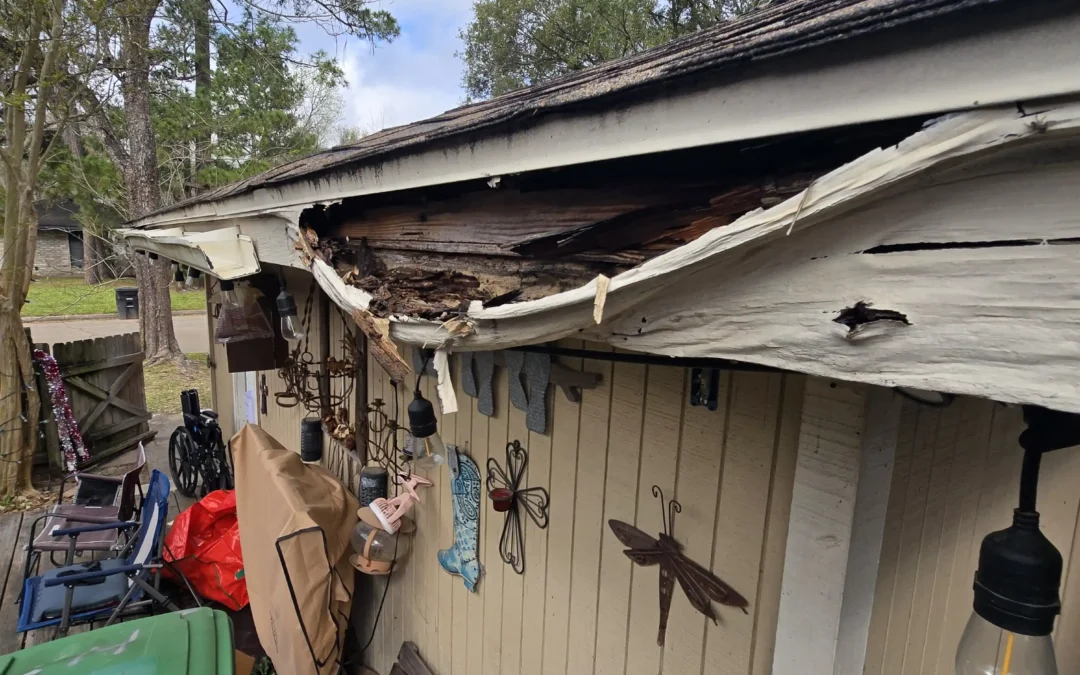
If you see water running behind gutters during a storm, the problem is usually not the rain itself. Water is missing the gutter trough or escaping behind it because something along the roof edge is not working correctly. The cause may be a drip-edge issue, poor gutter placement, incorrect pitch, loose hangers, or a backed-up outlet. Left alone, that repeated moisture can damage fascia, stain soffits, and send water where it does not belong.
For Greater Houston homeowners, this is worth checking sooner rather than later. Our heavy downpours can expose a small roofline problem very quickly.
Why Is Water Dripping Behind My Gutters Instead of Flowing Inside?
A properly installed gutter should catch runoff as it leaves the roof edge and carry it toward the downspouts.
When water gets behind the gutter instead, we usually look at a few specific areas first:
- The drip edge and roof-edge flashing
- Gutter height and position
- Pitch toward the downspout
- Loose or failing hidden hangers
- Leaking corners
- Clogged outlets or downspouts
- Heavy runoff below roof valleys
The important point is that water behind gutters is not always a clogging problem. We see systems that are perfectly clean and still leak behind the fascia because the gutter is sitting too low, pulling away, or not lined up correctly with the roof edge.
Drip Edge and Gutter Apron Problems
The drip edge is the metal flashing installed along the edge of the roof. At the eave, it should help guide runoff away from the roof edge and toward the gutter.
Problems start when that transition is wrong.
For example, we may find:
- A drip edge that does not extend far enough toward the gutter
- A visible gap between the flashing and the gutter
- A gutter installed below the path of the runoff
- Bent or damaged roof-edge metal
- Previous roof or gutter work that changed the original alignment
Water does not always fall straight down. Because of surface tension, it can follow the underside of a roof edge or flashing detail before dropping. If the gutter is not positioned to catch that water, it can end up directly against the fascia.
Some rooflines may also use a gutter apron or another flashing detail to bridge that transition.
A drip edge gutter problem should be inspected before anyone starts adding caulk everywhere. Sealant can help in the right location, but it does not correct bad flashing geometry or poor gutter placement.
Improper Gutter Placement and Pitch
A gutter can be brand-new and still perform poorly if it is installed in the wrong position.
We look at two separate things: where the gutter sits and where the water flows once it enters.
If the gutter is too low below the roof edge, fast-moving runoff may shoot past it. This becomes especially noticeable under steep roof sections and valleys.
If the gutter does catch the water but does not have the correct pitch, the water may collect in a low section instead of moving toward the downspout.
Typical warning signs include:
- Standing water after the rain stops
- Overflow in the middle of a gutter run
- One end draining while the other stays full
- Visible sagging
- Water spilling behind only one section
Greater Houston storms put much more water into a gutter system than a light shower. A minor alignment problem can appear harmless most of the year and become obvious during a strong thunderstorm.
For a deeper look at whether an existing system should be corrected or replaced, see [Link to: Gutter Repair vs Replacement].
Loose Hangers and Gutters Pulling Away From the Fascia
Most seamless gutters are supported by hidden hangers installed along the fascia.
Those hangers are only as good as the material they are attached to.
Over time, a gutter may start pulling away because of:
- Loose fasteners
- Weak hanger spacing
- Heavy debris
- Standing water
- Previous installation problems
- Water-damaged fascia
Once the back of the gutter separates from the fascia, water can get through that gap.
We also see the reverse happen: water gets behind the gutter first, softens the fascia over time, and then the hangers begin to loosen because the wood no longer holds the fasteners properly.
That is why gutters leaking behind fascia should be checked as a roofline problem, not just sealed from the outside.
Clogged Outlets Can Make a Clean Gutter Overflow
One of the more confusing situations for homeowners is a gutter that looks completely clean but still overflows.
The blockage may be lower in the system.
Leaves, roof grit, or small debris can collect inside:
- The outlet opening
- Downspout elbows
- Lower downspout sections
- Underground drainage connections
If water cannot leave the gutter as quickly as the roof is filling it, the water level rises until it spills somewhere.
Sometimes it goes over the front. Sometimes it finds the space between the gutter and fascia.
If overflow continues after the gutter has been cleaned, the downspout and outlet should be checked before assuming the gutter itself is defective.
Can Water Behind Gutters Rot Fascia Boards?
Yes, repeated wetting can contribute to fascia deterioration.
Greater Houston’s humidity makes this especially important because shaded or poorly ventilated wood may stay damp longer after a storm.
Look for:
- Peeling or bubbling paint
- Brown or dark streaks
- Damp soffit panels
- Soft wood around gutter fasteners
- Separation at fascia joints
- Mold or mildew-like staining
- Gutters beginning to sag
One stain does not automatically mean the fascia is rotten. Dirt, algae, or an old paint issue can look similar from the ground.
But when staining appears together with softness, repeated paint failure, or a loose gutter, we want to know where the moisture is coming from before the damage spreads.
See [Link to: Fascia Repair Guide] for more information on evaluating fascia damage.
A Simple Ground-Level Inspection Checklist
Homeowners can learn quite a bit without climbing onto the roof.
During a safe rainfall or immediately afterward, stand back and look for:
- Water between the gutter and the fascia
- One section overflowing while the rest drains normally
- Water shooting over the gutter below a roof valley
- Damp or stained soffits
- Peeling fascia paint
- Gaps behind the gutter
- Gutter sections that are visibly lower than the rest
- Slow or backed-up downspouts
- Water collecting near the foundation
- Corners that continue dripping long after the rain stops
Do not try to inspect a wet roof or work from an unsecured ladder.
What Can Be Cleaned and What Usually Needs Repair?
Some issues may be simple maintenance.
A homeowner may be able to clear visible leaves around an accessible outlet or remove debris from a safe ground-level discharge point.
Other problems usually need a physical inspection.
These include:
- Drip-edge corrections
- Gutter apron adjustments
- Re-pitching a gutter run
- Realigning seamless gutters
- Replacing failed hidden hangers
- Correcting roof-valley runoff
- Repairing rotted fascia
- Reworking downspout placement
- Replacing an undersized or badly installed system
We do not recommend repeatedly sealing the back of a gutter when the actual problem is alignment, flashing, or damaged wood. That usually treats the symptom instead of the source.
For replacement options, see [Link to: Houston Seamless Gutter Installation Service].
Frequently Asked Questions
Why is water running behind my gutters?
The usual causes are poor gutter placement, drip-edge problems, sagging sections, loose hangers, leaking corners, or water backing up from a restricted outlet or downspout.
How do you fix a drip edge gutter problem?
The repair depends on the roof edge. The gutter may need repositioning, the flashing may need adjustment, or an appropriate gutter-apron detail may be required.
Can water behind gutters rot fascia boards?
Repeated moisture can contribute to wood decay, especially when paint or sealant has already failed and the fascia remains wet after storms.
Should water behind gutters be repaired quickly?
It should be inspected before repeated storms continue wetting the same roof-edge materials. The proper repair depends on finding the actual water path first.
Fix the Water Path, Not Just the Visible Leak
Water running behind gutters usually tells us that something in the roofline drainage system needs attention. It may be a small alignment correction, or it may involve the drip edge, downspout capacity, gutter pitch, roof-valley runoff, or damaged fascia.
The right repair starts by watching how the water moves.
TXN Home Services provides gutter and roofline inspections throughout Greater Houston. We evaluate the gutter position, pitch, fascia condition, flashing, downspouts, and runoff patterns before recommending repair or replacement.
Call or text TXN Home Services at 346-460-9199 or visit TXNHomeServices.com to schedule a free gutter and roofline inspection.
Built to last. Proven to protect.
