
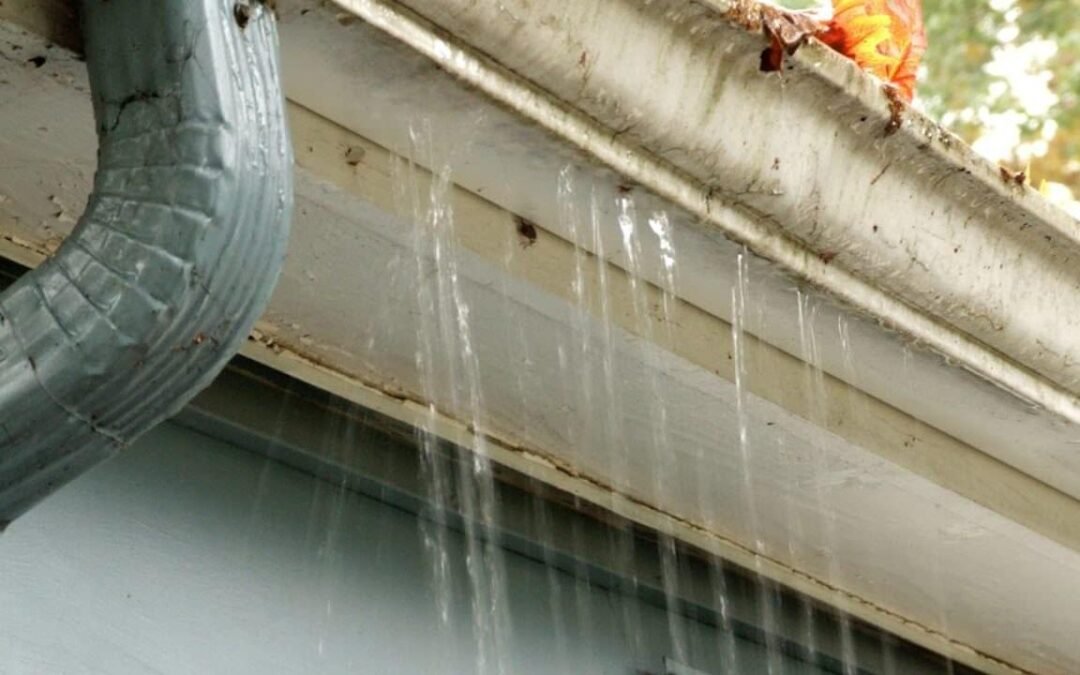
When a clean gutter overflows near a corner or downspout, the gutter trough may not be the real problem. Common downspout problems include restricted outlets, debris trapped inside elbows, inadequate downspout capacity, too few outlets for the roof area, or a blocked underground discharge line. If water cannot leave the gutter as quickly as it arrives, it backs up and spills over.
For Greater Houston homes, that drainage bottleneck becomes much more noticeable during intense thunderstorms when a large amount of roof runoff reaches the gutter in a short period.
Why Is Water Overflowing Right Above My Downspout?
Overflow directly above a downspout is one of the clearest signs that the entire drainage path should be checked.
The restriction may be at:
- The gutter outlet
- The first elbow
- A vertical downspout section
- The lower elbow
- A ground extension
- An underground drainage connection
A clogged downspout can exist even when the gutter itself looks completely clean.
Leaves, pine needles, twigs, seed pods, and roof grit can wash toward the outlet and collect at a bend where they are difficult to see from above.
That is why cleaning the trough alone does not always solve overflow.
See [Link to: Why Clean Gutters Still Overflow During Heavy Rain] for other drainage issues that can create similar symptoms.
Are 2×3 Downspouts Too Small for Greater Houston Heavy Rain?
Not automatically.
A properly designed 2×3 downspout can work well on many homes. The correct size depends on the amount of roof feeding the gutter, roof pitch, valley concentration, rainfall intensity, gutter size, outlet size, and the number of downspouts.
However, a larger 3×4 downspout provides substantially more internal area for water and debris to move through.
A nominal 2×3 downspout has approximately 6 square inches of cross-sectional area, while a 3×4 has approximately 12 square inches. That does not mean every installation will deliver exactly twice the drainage capacity because elbows, outlet openings, run configuration, and rainfall conditions also affect flow.
SMACNA sizes gutters and downspouts based on rainfall intensity and contributing roof area rather than relying on one downspout size for every building.
For homes with large roof sections, concentrated valleys, or recurring overflow during storms, evaluating undersized downspouts may be worthwhile.
See [Link to: 5-Inch vs 6-Inch Gutters for Houston Homes] for more information on overall system capacity.
Gutter Outlet Problems Can Create a Bottleneck
The downspout cannot move more water efficiently than the opening feeding it allows.
The gutter outlet is the transition between the horizontal trough and vertical downspout. If that opening is too restrictive for the system, it can become a pinch point during heavy runoff.
Problems may include:
- An outlet that is small relative to the downspout
- Poorly cut outlet openings
- Debris collecting around the opening
- Roof grit accumulating at the outlet
- Deformed metal restricting the transition
This is why simply attaching a larger downspout does not automatically solve every capacity problem. The gutter outlet problem also needs to be evaluated.
When appropriate, a contractor may enlarge or replace the outlet so the gutter and downspout work as a coordinated drainage path.
How Do Clogged Elbows Cause Gutter Backflow?
Downspout elbows change the direction of water, but those bends also create locations where debris can lodge.
The upper elbow is especially important because leaves or twigs entering the outlet may turn sideways and become trapped.
Once that happens, smaller debris collects behind it.
Homeowners may notice:
- Water pouring over directly above the downspout
- A downspout producing very little discharge during heavy rain
- Water leaking around elbow joints
- Slow drainage after the storm
- Debris washing over the gutter instead of exiting below
A lower elbow can create the same problem.
If the gutter fills while very little water comes from the bottom of the downspout, an internal restriction should be investigated.
Too Few Downspouts Can Overload a Long Gutter Run
There is no single downspout-spacing rule that is correct for every house.
The appropriate number depends on roof catchment area, rainfall intensity, gutter dimensions, outlet capacity, and where roof valleys concentrate runoff.
SMACNA notes 50 feet as a practical maximum gutter length served by one downspout in its sizing guidance, while actual drainage calculations may require additional outlets depending on the system.
On a long seamless run, adding another properly located outlet and downspout may sometimes improve drainage more effectively than repeatedly modifying gutter pitch.
This is especially relevant when overflow consistently occurs far from the existing outlet.
Underground Drainage Can Back Up the Downspout
The problem does not always stop at the bottom elbow.
Some homes discharge into underground piping. If that line is crushed, filled with roots or debris, poorly sloped, or otherwise restricted, the downspout may have nowhere to discharge during a storm.
Water can then rise through the connected drainage path and slow the entire system.
EPA guidance recommends testing underground drains to verify they are working and emphasizes directing roof runoff away from the house rather than allowing it to remain near the foundation.
Ground-level discharge can also fail when:
- Extensions are crushed
- Flexible pipe is kinked
- The outlet terminates in a low area
- Landscaping blocks the discharge
- Soil or mulch covers the opening
Greater Houston Storms Expose Drainage Weaknesses Quickly
The Houston metropolitan area is particularly vulnerable to rapid runoff during heavy rainfall. The National Weather Service notes that urban development can significantly increase runoff compared with natural terrain.
That matters at the house level too.
A minor downspout drainage problem may appear harmless during light rain but become obvious when roof runoff increases quickly.
Poor discharge can lead to:
- Gutter overflow
- Landscape washout
- Water collecting near walkways
- Saturated soil near the foundation perimeter
- Repeated moisture exposure around fascia and soffit
FEMA recommends maintaining gutters and downspouts so rainfall can flow away from the building.
A Ground-Level Downspout Checklist
You can identify several warning signs without climbing onto the roof.
During a safe rainfall, look for:
- Overflow concentrated directly above a downspout
- Very little water exiting a downspout while the gutter is full
- Water leaking around elbow joints
- A crushed or disconnected ground extension
- Mulch or soil displaced around the discharge point
- Water pooling close to the house
- Slow drainage after the rain ends
- One downspout carrying far more water than the others
After the storm, you may gently tap accessible downspout sections. A sudden change from a hollow sound to a duller section can suggest debris, although it is not a definitive clog test.
How Contractors Correct Downspout Problems
The correct repair depends on where the restriction or capacity problem occurs.
Possible improvements include:
- Clearing a clogged elbow or downspout
- Correcting or enlarging the gutter outlet
- Upgrading from 2×3 to 3×4 downspouts where appropriate
- Adding an additional downspout to a heavily loaded run
- Correcting damaged elbows
- Installing better discharge extensions
- Adding accessible cleanouts to appropriate underground systems
- Realigning the gutter so water reaches the outlets correctly
The goal is not simply to install the largest components available. It is to match the gutter, outlets, downspouts, roof runoff, and discharge path to the home.
See [Link to: Seamless Gutter Installation & Downspout Services].
Frequently Asked Questions
How many downspouts does a house typically need?
There is no universal number. Downspout quantity should be based on roof area, gutter length, rainfall intensity, roof valleys, gutter capacity, and outlet placement.
How do I know if my downspout is clogged inside the elbow?
Overflow above the outlet, weak discharge below, or water leaking around elbow joints can indicate an internal blockage. The downspout should be inspected and flow-tested to confirm it.
What is the advantage of 3×4 downspouts over 2×3?
A 3×4 downspout provides greater internal area, allowing more room for runoff and debris. Whether an upgrade is necessary depends on the roof area, gutter size, outlets, and drainage layout.
Can downspout overflow damage my home foundation?
Repeatedly concentrating roof runoff near the foundation can create moisture and drainage concerns. Downspouts should discharge water away from the structure through an appropriate surface or underground drainage path.
Fix the Bottleneck Before Replacing the Whole System
Downspout problems can make a perfectly clean gutter overflow. The real cause may be an elbow clog, restrictive outlet, inadequate downspout capacity, poor outlet placement, or a blocked discharge line.
TXN Home Services provides gutter and downspout drainage evaluations throughout Greater Houston. We inspect the gutter run, outlets, elbows, downspouts, fascia, and final discharge path before recommending cleaning, repair, additional outlets, 3×4 downspouts, or system upgrades.
Call or text TXN Home Services at 346-460-9199 or visit TXNHomeServices.com to schedule a free on-site gutter and drainage evaluation.
Built to last. Proven to protect.