
Heavy thunderstorms, tropical weather, and sudden downpours can send a large volume of roof runoff toward a home’s gutters within minutes. In Greater Houston, the challenge is not simply how much rain falls over an entire day. The bigger concern is often the amount of water that reaches the roofline during a short, intense storm.
When gutters are undersized, misaligned, partially clogged, or paired with an unsuitable gutter guard, water may spill over the front, run behind the gutter, or overshoot the system completely. Choosing the best gutter guards for heavy rain therefore requires more than selecting a product that blocks leaves. Effective heavy-rain gutter protection must support rapid water entry while working with the gutters, downspouts, roof valleys, and drainage path below.
The Reality of Greater Houston Storms and Gutter Overflow
Gutter overflow is rarely caused by one issue alone. It usually results from several roofline and drainage conditions working together.
During a strong Greater Houston storm, a steep or expansive roof can produce rapid roof runoff. Roof valleys may concentrate water into a relatively small gutter section, while oak leaves, pine needles, seed pods, and roof shingle grit can restrict outlets when the system needs its maximum drainage capacity.
Common causes of gutter guards overflowing in heavy rain include:
- Leaves or organic material covering the guard surface
- Pine needles and roof grit collecting near low points
- Clogged or undersized downspout outlets
- Gutters that are too small for the contributing roof area
- Incorrect gutter slope
- Sagging sections caused by loose or widely spaced hangers
- Concentrated runoff below large roof valleys
- Poor gutter alignment along the roof edge
- Incorrect integration with the drip edge
- Gutter guards installed at an unsuitable angle
Overflow may appear as water pouring over the front of the gutter, but it can also occur behind the system. When water repeatedly travels between the gutter and fascia, it may contribute to staining, deterioration, or rot in the fascia boards and soffit area.
Water discharging too close to the home can also saturate landscaping and increase moisture around vulnerable areas of the foundation perimeter. Gutters alone cannot solve every exterior drainage problem, but a properly designed roofline system helps direct runoff toward suitable discharge locations.
That is why gutter guards for Greater Houston storms should be evaluated as part of a complete water-management system rather than as a stand-alone accessory.
Water Flow Capacity: How Guard Design Handles Heavy Runoff
Different gutter guard designs manage water and debris in different ways. The primary categories include basic screens, reverse-curve systems, and stainless steel micro-mesh.
Basic Gutter Screens
Standard screens generally use larger openings to block leaves and other visible debris. They can be practical in some conditions, but smaller material may pass through the openings or collect around them.
Pine needles, seeds, and roof grit may enter the gutter or accumulate near the downspout outlet. During heavy rain, that buildup can reduce water flow even when the top of the screen appears relatively clear.
Reverse-Curve Gutter Guards
Reverse-curve guards use surface tension to direct water around a curved edge and into the gutter while debris is intended to fall away.
Their performance can depend on:
- The speed of the roof runoff
- Roof pitch
- Guard cleanliness
- Installation angle
- The shape of the leading edge
- The amount of water concentrated in roof valleys
Under certain conditions, fast-moving water may travel past the entry point rather than following the curve into the gutter.
Stainless Steel Micro-Mesh
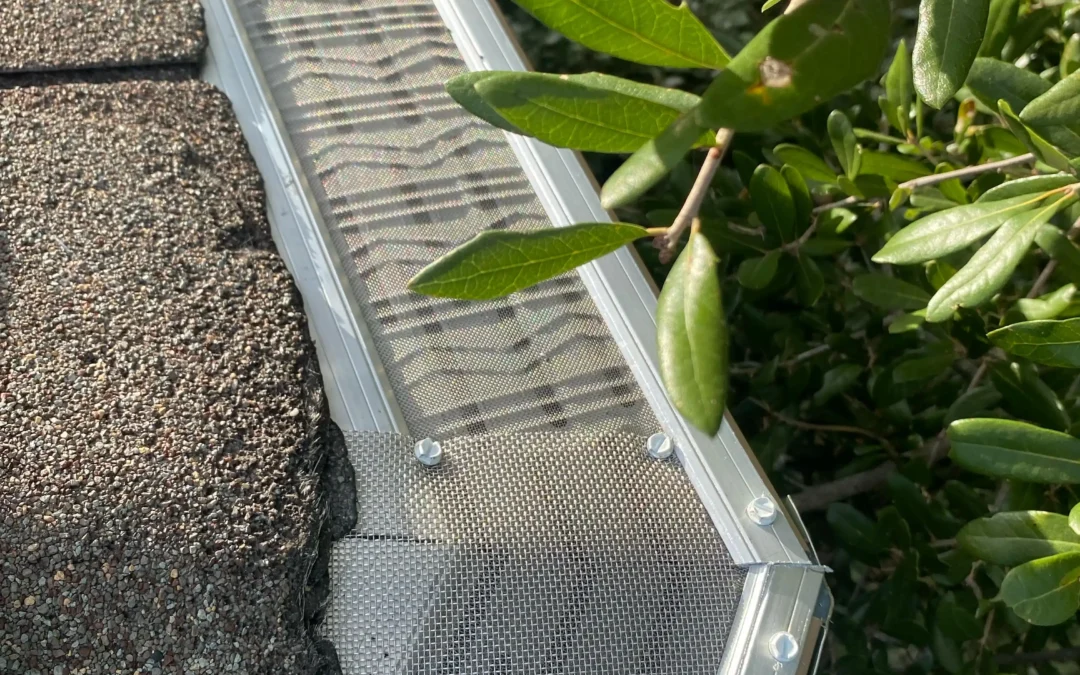
Micro-mesh gutter guards for heavy rain use many small openings to allow water into the gutter while helping restrict pine needles, small leaves, roof grit, and other fine debris.
Quality stainless steel micro-mesh is designed to provide multiple water-entry points across the guard surface. The mesh design, support frame, installation angle, and condition of the gutter below all influence gutter guard water flow.
LeafBlaster Pro® is a stainless steel micro-mesh gutter protection system designed to help manage rainwater while reducing the amount of debris entering the gutters. It can be an effective option for Greater Houston homes surrounded by oak trees, pine trees, and other vegetation that produces small debris.
However, even high-flow gutter guards cannot correct every drainage limitation. A blocked outlet, undersized downspout, sagging gutter, or major roof valley can still create overflow.
No gutter guard completely eliminates organic accumulation. Pollen, seeds, small branches, and roof grit may collect on top of the mesh over time. Periodic inspection and surface cleaning remain important, especially after major storms or extended dry periods.
Why Proper Installation Matters During Heavy Rain
Even the best gutter guards for heavy rain may perform poorly when installed over dirty, damaged, leaking, or incorrectly pitched gutters. A gutter guard does not repair an existing drainage problem by itself.
Before installing gutter protection, the existing system should be inspected for:
- Standing water
- Incorrect gutter slope
- Loose or damaged hangers
- Sagging gutter runs
- Leaking corners and end caps
- Open seams
- Clogged outlets
- Damaged fascia boards
- Gaps near the drip edge
- Misaligned downspouts
- Sections that are too small for the roof area
The gutters should be thoroughly cleaned before the guards are installed. Existing leaks should be resealed, weak hangers should be reinforced or replaced, and sagging sections should be realigned.
Drip Edge and Gutter Alignment
The drip edge, roof edge, and gutter position should work together so that runoff enters the gutter rather than traveling behind it.
The correct configuration may vary depending on the roof design, fascia profile, existing drip edge, and gutter mounting position. That is why the roof edge should be physically inspected instead of assuming one installation method is suitable for every property.
Roof Valleys and Concentrated Water
Roof valleys can direct a large volume of water toward a short section of gutter. Depending on the roofline, the system may require:
- A properly positioned splash guard
- A larger gutter section
- An additional downspout
- A larger outlet
- Revised gutter or downspout placement
- Better drainage at the discharge point
Installing high-flow gutter guards without addressing concentrated valley runoff may still leave the system vulnerable to overshooting or overflow.
5-Inch vs. 6-Inch Gutters: Does Size Affect Guard Performance?
Gutter size affects how much water the system can temporarily hold and move toward the downspouts.
Many Greater Houston homes have traditional 5-inch gutters. These systems may be adequate for smaller or less complex rooflines when they are correctly installed and supported by properly sized downspouts.
However, homes with larger roof areas, steep pitches, long gutter runs, or multiple valleys may benefit from greater capacity. In these situations, custom 6-inch seamless gutters paired with oversized downspouts can generally move more roof runoff than an older 5-inch system.
That does not mean every home automatically needs 6-inch gutters. The correct size depends on:
- Roof area
- Roof pitch
- Gutter run length
- Valley locations
- Rainfall intensity
- Number of downspouts
- Outlet size
- Available discharge locations
The best gutter guards for Greater Houston homes must be matched to a properly sized gutter and downspout system. A guard with strong water-entry performance cannot fully compensate for a severely undersized gutter, blocked outlet, or poorly positioned downspout.
Frequently Asked Questions
Do Micro-Mesh Gutter Guards Work in Heavy Rain?
Quality micro-mesh systems can perform well during heavy rain when they are installed correctly and paired with clean, properly sized, and correctly aligned gutters. Performance also depends on the roof pitch, roof valleys, downspout capacity, mesh angle, and the amount of debris on the guard surface.
Can Gutter Guards Cause Gutters to Overflow?
Gutter guards may contribute to overflow when they are installed incorrectly, covered by debris, or unable to accept concentrated runoff quickly enough. However, the guard is not always the main cause. Undersized gutters, blocked downspouts, poor gutter slope, sagging sections, and major roof valleys can also cause overflow.
What Causes Gutters to Overflow Even When They Are Clean?
Clean gutters may overflow because of incorrect slope, insufficient downspouts, small outlets, sagging sections, concentrated valley runoff, or gutters that are too small for the contributing roof area. Water may also overshoot the gutter when it moves quickly down a steep roof. Understanding these conditions is essential when determining how to prevent gutter guard overflow.
Are Micro-Mesh Gutter Guards Good for Pine Needles and Roof Grit?
Stainless steel micro-mesh is designed to help block pine needles, small leaves, seeds, and roof grit that may pass through wider screens. Some material may still collect on the mesh surface, so periodic inspection and light surface cleaning may be needed to maintain effective water entry.
Can Gutter Guards Be Installed on Existing Gutters?
Yes, gutter guards can often be installed on existing gutters when the system is structurally sound, properly aligned, correctly sloped, and free from major leaks. The gutters should be cleaned and inspected first. Damaged fascia, loose hangers, leaking corners, restricted outlets, and undersized sections should be corrected before installing gutter protection.
Choosing the Right Gutter Protection for a Greater Houston Home
There is no single out-of-the-box gutter guard solution that works equally well for every property. Roofline configuration, surrounding trees, roof pitch, gutter size, fascia condition, downspout layout, and the final drainage path all influence performance.
The best gutter guards for heavy rain should help reduce debris buildup while allowing water to enter efficiently. They should also be installed over a clean, repaired, properly aligned gutter system with enough drainage capacity for the roof area it serves.
TXN Home Services provides detailed gutter and roofline inspections throughout Greater Houston. Our professionally trained team evaluates fascia condition, gutter alignment, gutter slope, roof valleys, existing gutter capacity, and downspout placement before recommending a custom gutter protection solution designed for Greater Houston weather.
An accurate recommendation and estimate require an on-site physical inspection because every roofline and fascia condition is different.
Call or text TXN Home Services at 346-460-9199 or visit TXNHomeServices.com to schedule a free gutter and roofline evaluation.